2027 presidency: What are the running mates bringing to the tickets?
As the January 16, 2027, presidential race takes shape, the running mates chosen by each candidate reveal as much about their tickets’ weaknesses as their strengths. PHILIP IBITOYE x-rays the antecedents, political capital and vulnerabilities of the vice-presidential picks across the field, concluding that some of the presidential running mates are more than merely filling the space.
ON Saturday, August 1, 2026, the Independent National Electoral Commission (INEC) published the particulars of all presidential candidates for the January 16, 2027, contest, including their vice-presidential nominees. Needless to say that the choice of running mate is one of the most important pre-election rituals in Nigerian politics; often a make-or-mar decision for candidates seeking executive office. That said, the 2027 candidates have now made their beds ahead of a poll that will determine whether President Bola Tinubu retains his office or becomes only the second president dislodged by the opposition in Nigeria’s democratic history.
In this process, competence and capacity usually take a backseat, but not because those qualities do not matter to candidates, according to political analysts. Rather, candidates use the running mate slot to appeal to constituencies they do not command, adding numbers rather than consolidating an existing bloc. State of origin, region, ethnicity, religion, and political influence are what matter: a Yoruba candidate from the South does not pick an Igbo running mate from the South, however competent, because the target is the vote-rich North.
The same logic applies to religion, though it is complicated by how tightly religion is married to ethnicity in Nigeria. Northern Nigeria is dominated by Muslims, so a Muslim candidate picking a running mate from the region would still need someone who can win over that Muslim majority, a calculation that has produced the two major Muslim-Muslim tickets in recent Nigerian history. In the buildup to the annulled June 12, 1993, election, the Social Democratic Party’s (SDP) Moshood Kashimawo Olawale (MKO) Abiola, a Muslim from Ogun State, Southern Nigeria, picked Babagana Kingibe, a Muslim from Borno State, Northern Nigeria, as his running mate. More recently, in the run-up to 2023, the APC’s Bola Tinubu, a Muslim from Lagos State, Southern Nigeria, picked Kashim Shettima, a Muslim from Borno State, Northern Nigeria.
Both tickets — Abiola-Kingibe (albeit annulled) and Tinubu-Shettima — won, proof that the vote-rich Northern Muslim bloc has been a reliable bet over a Christian pairing. Tinubu has doubled down on that formula, retaining Shettima as his running mate for 2027.
Other candidates have made different calculations. Atiku Abubakar of the African Democratic Congress (ADC), a Muslim from the North, chose Rotimi Amaechi, a Christian from the South. Peter Obi of the Nigeria Democratic Congress (NDC), a Christian from the South, picked former Kano governor Rabiu Musa Kwankwaso, a Muslim from the North. Seyi Makinde of the Allied Peoples Movement (APM), a Christian from the South, went for Ibrahim Adamu Bala, a Muslim from Bauchi State.
Here is a closer look at what each of these running mates brings to their ticket, starting with the incumbent.
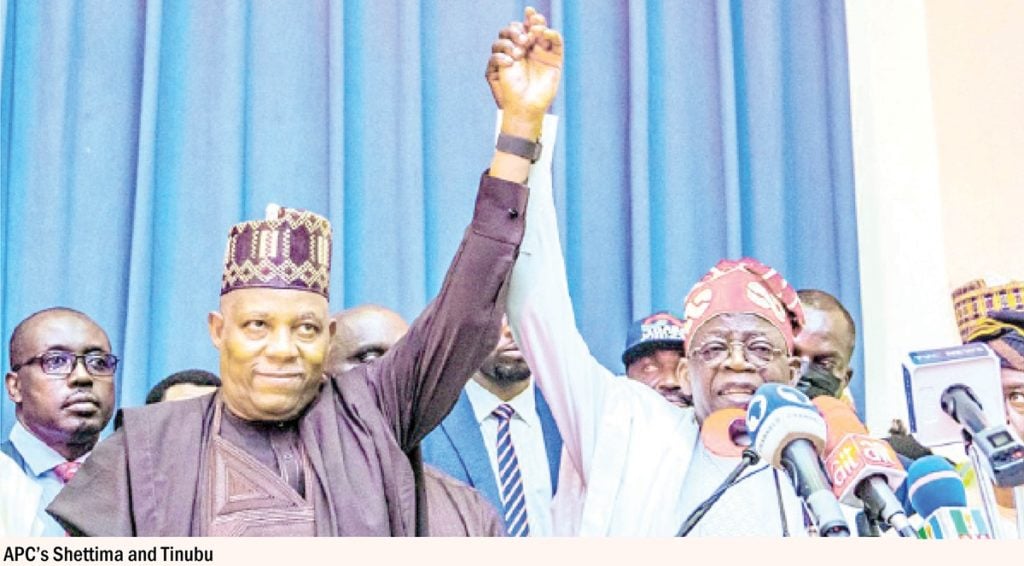
Kashim Shettima – APC
Shettima rose to national, and even global, prominence through a tragedy: the daring abduction of more than 270 schoolgirls from Government Girls Secondary School in the Chibok community, Borno State, in April 2014 (as many as 82 of them are believed to remain in Boko Haram captivity 12 years later). The APC vice-presidential nominee was the state governor at the time. Although the abductions were hardly a net positive for him being the governor on whose watch the girls were seized, his political stock rose as he fiercely criticised the military response to terrorism under President Goodluck Jonathan, including claiming that the Boko Haram terror sect was stronger than the Nigerian military.
A year later, Shettima cruised to re-election with 95 per cent of the vote, demonstrating remarkable political strength. He continued to steer the state’s affairs through the terror years, then moved to the Senate in 2019 as member for Borno Central.
By 2022, as the 2023 race took shape, Shettima had become one of the earliest and most vocal proponents of Tinubu’s candidacy, even infamously deriding then-Vice-President Yemi Osinbajo as a “nice man” who ought to be selling ice cream, not running for president, a remark he later apologised for. As Senate President Ahmad Lawan sought the APC ticket with backing from elements in the Buhari presidency, Shettima was instrumental in manoeuvring the Northern bloc toward Tinubu’s primary victory. His loyalty was rewarded when Tinubu picked him as running mate for 2023.
However, not long after the ticket’s hard-fought victory in 2023, reports began to emerge that their relationship had soured and that the president’s political operation was actively shopping for a new running mate. But all those speculations were laid to rest on July 10 after the nomination form of Shettima as vice-presidential candidate was presented to the APC national working committee (NWC).
Sunday Tribune learnt that the vice-president was retained after the intervention of his successor in Borno, Babagana Zulum, and other influential members of the North-Eastern political bloc who remained loyal to the former Borno governor.
Strengths
Beyond Shettima’s loyalty and political acumen, his choice was mostly pure electoral calculation. In 2023, he helped Tinubu stay competitive in the North-East, his home region and that of Atiku, the then PDP candidate. The APC won Borno, with voters choosing their son over a fellow North-Easterner in the former vice-president.
In Adamawa, Atiku’s home state, Shettima’s presence helped the APC close the gap with the PDP, weakening the former vice-president’s home advantage. Across the wider North, the APC performed well enough to push it to victory. As 2027 approaches, Shettima retains the same advantage.
Weaknesses
A dogma that has continued to follow Shettima years after leaving office as Borno governor is the degeneration of security in the state under his watch, though possessing limited control in Nigeria’s centralised federal system. The president’s alleged hesitation to stick with him has also signalled to many in the political space that he has lost some influence in the president’s orbit and his geopolitical zone.
Also, despite winning on a Muslim-Muslim ticket in 2023, the imbalance remains a sticking point in political debates and will remain a talking point among many Christians heading into the 2027 polls. But since the ticket won while outside power in 2023, it is hard to bet against it as an incumbent in 2027.
Not a few would point to his management of the Chibok girls’ kidnapping saga as a stain on his administration and his name. Many would believe that the development might also have stained him not just locally, but internationally.
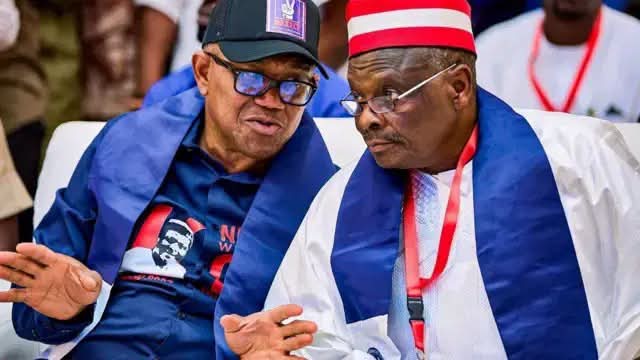
Rabiu Musa Kwankwaso —NDC
Kwankwaso’s political career stretches back to 1999, when he first won the Kano governorship. He lost his re-election bid in 2003 but returned to the seat in 2011 for a second term, building the grassroots network — the Kwankwasiyya movement, instantly recognisable by its red caps — that has defined his politics ever since.
In between, he served briefly as Minister of Defence under President Olusegun Obasanjo and later represented Kano Central in the Senate from 2015. In 2022, frustrated with the PDP, he joined the New Nigeria Peoples Party (NNPP) and ran on its platform in the 2023 presidential election, finishing fourth nationally but topping the polls comfortably in Kano State with nearly one million votes. He has now moved to the NDC as Obi’s running mate for 2027.
Strengths
Kwankwaso draws his political strength from the enduring loyalty of the Kwankwasiyya movement, which remains one of the most disciplined and mobilisable political followings in the North-West.
The red cap army is often intimidating to political opponents in Kano, and its capacity to turn out voters on command is precisely the kind of retail political muscle Obi lacked in 2023, when his support was concentrated almost entirely in the South-East and pockets of the South-South and South-West. Pairing with Kwankwaso is a direct attempt to fix that gap by borrowing a ready-made Northern voting bloc rather than building one from scratch.
Weaknesses
Despite wielding considerable influence in Kano State, Kwankwaso’s reach is mostly limited to that state, according to data reviewed by Sunday Tribune from the 2023 elections. Running as the NNPP presidential candidate that year, he only won his home state, managing more than 20,000 votes in just five others — all North-West or North-East, none above 100,000. Obi’s primary reason for aligning with Kwankwaso was to make inroads in the North, where his poor 2023 showing cost him the election, but the numbers suggest the former Kano governor may not hold as much influence as the top of the ticket assumed.
Worse still, some observers believe that Kwankwaso’s influence in Kano has only weakened since 2023. In 2023, he had the support of his son-in-law, Abba Kabir Yusuf, now governor, but the two have since fallen out, fracturing his Kwankwasiyya base. Given his long history of falling out with allies — including former Governor Abdullahi Ganduje and former Deputy Governor Nasir Yusuf Gawuna — he may be short of allies in his own state, limiting how much he can actually deliver for the NDC ticket. But not a few will point to his legendary charisma, with which they say he has been able to fascinate lots of grassroots Kano to his side. How much of the charm is left in his remains to be seen.
Rotimi Amaechi —ADC
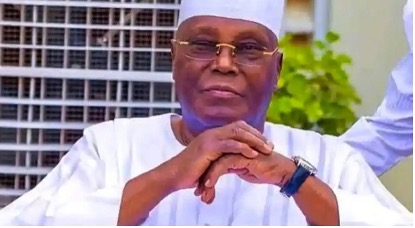
Not many politicians in Nigeria understand the value a running mate brings to a ticket more than Atiku, who is at the top of the ADC ticket with Amaechi. He was a very influential vice-president, and it even took former President Olusegun Obasanjo kneeling before him to accept to remain his running mate in the 2003 presidential election, according to Nobel laureate Wole Soyinka. But he has not had much luck picking running mates for himself since. In 2019, he picked Obi, who would abandon him four years later, and in 2023 went for Ifeanyi Okowa, who would join his rival’s camp in less than three years. This time, he has picked a former State Assembly speaker, governor, and minister, Rotimi Amaechi, who had initially vowed not to be anybody’s running mate.
Amaechi is no doubt a political juggernaut himself. Rising from a rank-and-file state lawmaker to Speaker and a powerful governor who went to war with the presidency, under President Jonathan. He served as Minister of Transportation under Buhari from 2015 to 2023, overseeing the Lagos-Ibadan and Warri-Itakpe standard gauge rail lines, before losing the APC’s 2022 presidential primary to Tinubu. He decamped to the ADC in 2025, ran second to Atiku in the party’s chaotic May 2026 primary, and was unveiled as running mate in June after months of publicly insisting he wanted the top job for himself.
Strengths
Amaechi’s clearest asset is goodwill beyond his own state, particularly in the North-West. In February 2022, the Daura Emirate Council in Katsina — Buhari’s home turf — turbaned him “Dan Amanar Daura” (“Trusted Son of Daura”), citing the federal projects, including a university of transportation, that his ministry brought to the area. He wore the regalia again at Buhari’s burial in July 2025, underlining a relationship with the core North few Southern politicians of his stature can claim.
Within Rivers, he is not without loyalists either: an older APC bloc tied to Tonye Cole still resists ceding ground to the Fubara camp, and an ADC ally, Gabriel Pidomson, is positioning for the 2027 governorship, giving Amaechi at least a foothold rather than nothing.
Weaknesses
The bigger problem is that Amaechi does not control Rivers State anymore, and it is not close. That belongs to Nyesom Wike, now FCT Minister under Tinubu and still the dominant force in Rivers: his camp is widely believed to have installed the 23 sitting local government chairmen during last year’s state of emergency, a grip on grassroots mobilisation neither Fubara nor Amaechi’s old structure can match. With Wike aligned with the ruling APC, Amaechi’s home state is hostile territory for the ADC ticket, not a delivery vehicle.
That bleeds into the bigger question of whether Amaechi can counter Obi’s pull across the South-South. On the numbers, he cannot: Obi won every state in the zone in 2023 bar Bayelsa, and nothing in Amaechi’s current standing — a contested home state and no comparable network in Akwa Ibom, Delta, Cross River or Edo — suggests he can dent that performance. His usefulness to Atiku looks less like commanding a South-South bloc and more like offering a bridge to the North his rivals cannot match.
However, what appears on the surface may not completely account for some latent strengths which he possesses. The fact that he has stayed so long in the public eye means he has made a lot of friends who could be of use to him at this critical time. Amaechi may possess; the fact that he has stayed so long on the political scene could be a plus to his ambition going forward.
Other running mates bring a mix of strengths and weaknesses
On the APM side, Makinde picked Ibrahim Adamu Bala, a 51-year-old Bauchi State politician, giving the ticket a South-North balance. Bauchi governor, Bala Mohammed — often wrongly assumed to be the running mate himself, a mix-up APM has had to publicly correct — is understood to have brokered the pick and has since publicly endorsed Makinde’s candidacy. But that endorsement is not a ticket position, and it leaves open how much organisational muscle APM can actually draw on in the North-East beyond Bauchi.
The Labour Party’s Chibuzo Okereke, a Christian from Abia State, picked Hajja Bintu Konto, a Muslim from the North, as his running mate. Konto is a public health specialist with more than three decades of field experience, much of it coordinating displacement response in Borno, Adamawa and Yobe for Catholic Relief Services. It reads as a technocratic, inclusion-driven pick rather than a political one: fluency across five Northern languages, a clean profile, but no independent voting bloc, leaving LP without the retail muscle Obi’s 2023 run enjoyed.
On the PDP side, Senator Sandy Onor of Cross River picked Babangida Modibbo Umaru, the party’s North-East Vice-Chairman, from Adamawa, giving a South-South/North-East balance. Both men are low-wattage nationally, and PDP currently fielding two competing tickets undercuts whatever momentum either pairing might carry.
Further down the ballot, the Action Democratic Party’s (ADP) Ambassador Aliyu Bin Abbas, a Sokoto-based former Atiku aide, named Hon. Chinazam Ike of Imo State as running mate, pitching it as a “generational shift” ticket. Ike’s background is private-sector — housing development, youth advocacy — rather than political, and like most smaller-party pairings, the ticket has no electoral history to draw on.
A three- or four-horse race?
In 2023, Nigeria saw a keenly contested election between Tinubu, Atiku, and Obi, where a different result in a few states could have swung the outcome. All three are set for a rematch in 2027, but some observers are asking whether Makinde could make it a four-horse race by playing spoiler in the South-West and eating into Tinubu’s advantage there.
In a recent interview with Sunday Tribune, the APC spokesman, Felix Morka, said that will not be the case, saying the Oyo governor and other presidential candidates from the South have no capacity to split the president’s support.
“How can you dissipate what you don’t have any foothold to challenge? I wish them a lot of luck if that’s their game plan… None of the people [Southern presidential candidates] you mentioned begin to pose a threat to President Tinubu or the APC in the upcoming election. Because, like I said, you can’t bring emptiness to challenge a solid record,” he said.
Taken together, the running-mate calculus for 2027 shows where each ticket believes its weaknesses lie. Tinubu is defending, not building, hence the stuck-with partnership despite its friction. Atiku and Obi are patching the same hole — Northern reach for Obi, Southern depth for Atiku — with mates whose numbers, on inspection, are less commanding than their reputations suggest. Makinde is betting a Bauchi endorsement can stand in for real North-East infrastructure.
The remaining tickets are still building name recognition. None of it will be tested until January 16, 2027, but the gap between what these running mates are supposed to deliver and what they can actually deliver may be wider than most tickets would like to admit.